TheFrequency
What if perception itself could change reality? And what if something ancient had always known it?
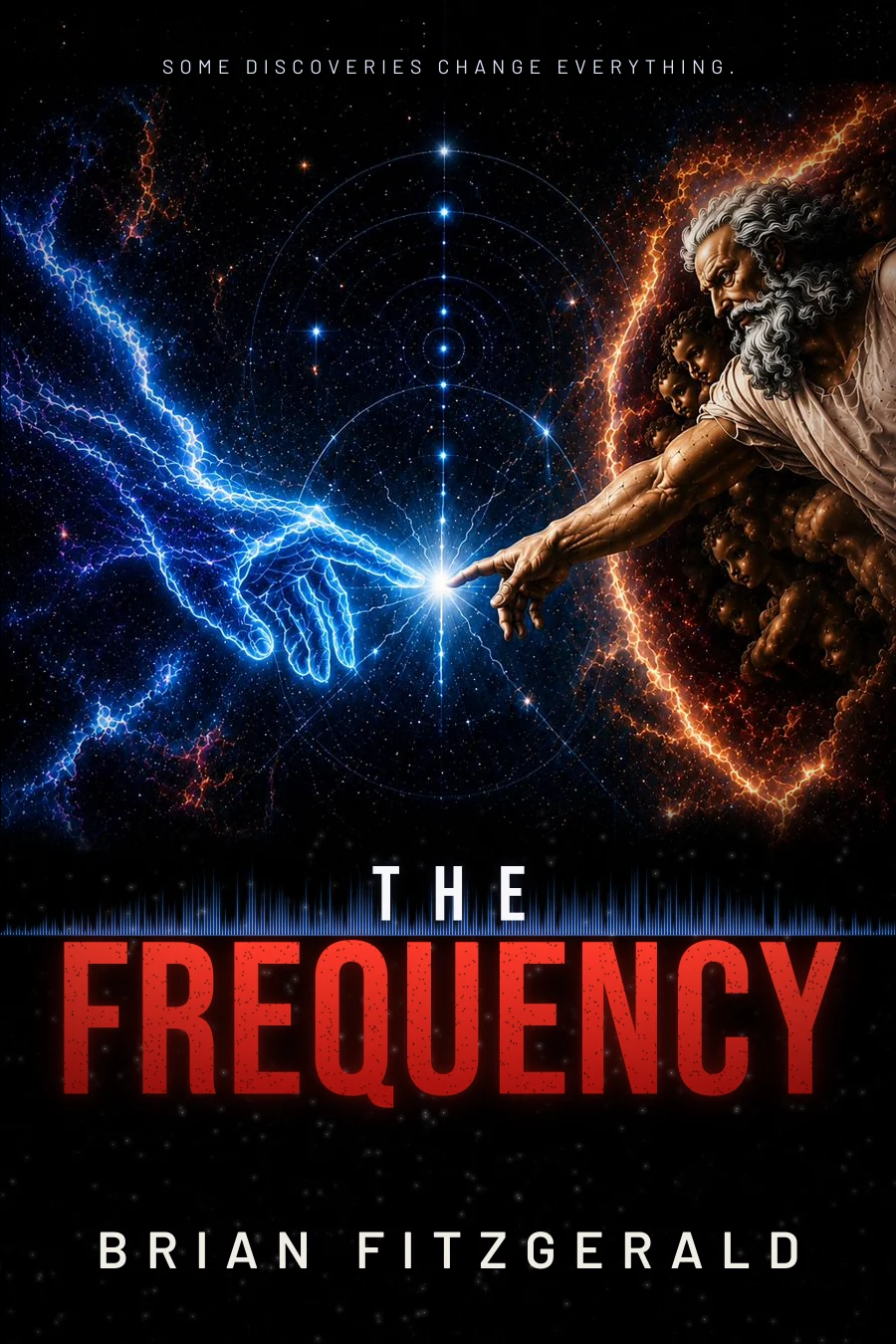
Two lottery wins. One man who can't explain either.
After twenty-six years in the police, thirteen of them in custody, Sergeant Ryan Vincent can tell when a night is about to go wrong. Lately that instinct has followed him home. The lights hurt his eyes. His blood pressure is climbing. And one morning at a petrol station he chooses six numbers without knowing why.
They win £13 million.
Days later he does it again, for £43 million, and a man called Jake Hunter turns up at his door, polite and well prepared, with a lot of questions about the odds.
Ryan does what he has always done with a problem. He tests it. He writes everything down, changes one thing at a time and refuses to believe anything he can't check. The results are hard to explain and keep getting harder. His father, Michael, has been blind for eight years and has never said why. Leah, the woman he loves, can see he is hiding something. A man called Adrian knows far more than he admits. And somewhere past the edge of what Ryan can see, something has noticed that he is looking.
A slow-building supernatural thriller set in Manchester and the Lake District, about consciousness, secrecy and the cost of paying attention.
The science and history behind the series
The Frequency is a novel, and none of this is needed to enjoy it. These are the real ideas that inspired the series, with the claims kept to what the evidence supports.
Schumann Resonance
Extremely low-frequency electromagnetic resonances in the cavity between Earth's surface and its ionosphere, predicted by physicist Winfried Otto Schumann in 1952. The strongest sits close to 7.83 Hz. Nikola Tesla's experiments at Colorado Springs in 1899 explored the Earth as an electrical resonator.
Schumann, 1952 · Tesla, 1899Binaural Entrainment
Two slightly different tones, one in each ear, produce a perceived third beat. Theta-range beats are studied for effects on relaxation and attention, and the results so far are mixed.
Auditory beat researchThe Eye Within
The pineal gland sits near the centre of the brain and is not divided between the hemispheres. It produces melatonin. In 2000 psychiatrist Rick Strassman proposed that it might also produce DMT, a hypothesis that remains unproven.
Strassman, DMT: The Spirit Molecule, 2000The Filter That Lowers
The Reticular Activating System helps regulate arousal and which sensory information reaches conscious attention. Stress physiology links prolonged strain with heightened vigilance. The series asks what might happen if that went further.
Neuroscience & stress physiology literatureWhat Gets Passed On
Research suggests that sustained stress and trauma can alter gene expression without changing the DNA itself, and animal studies indicate that some effects can be passed on. How far this applies to people is still debated.
Meaney, McGill · Dutch Hunger Winter cohortAn Old Map, Redrawn
In the early 1500s Leonardo da Vinci cast the ventricles of the brain in wax and wrote that the “common sense” is the seat of the soul. The Tibetan Book of the Dead, attributed to the eighth century, describes the passage of consciousness after death as a set of instructions.
Richter, The Notebooks of Leonardo da Vinci · Tibetan Buddhist traditionStart reading now
The opening pages of Chapter One. Free, no purchase required.
Numbers
Custody never really slept.
It just got quieter sometimes.
At three in the morning the custody block in Manchester was as busy as it ever was at midday. The LED strips overhead threw the same flat white light into every corridor and holding area, with no corners to hide in and no window to tell you what the sky was doing. Once the heavy doors sealed behind you, the day stopped meaning anything.
Ryan Vincent had worked in places like this for years, so it made no sense that the lights had started to hurt. They seemed to have been turned up when nobody was looking. He sat behind the custody desk staring at a screen he could barely read, and tried not to rub his eyes again.
Down the corridor a prisoner hammered on his cell door and another started shouting. An intercom buzzed. Someone wanted medication, someone else wanted food, and a third man was demanding a cigarette for the tenth time.
A normal night shift.
Ryan was used to noise. After twenty-six years in the police, thirteen of them in custody, he should have been. Lately every sound arrived separately and a little too sharp: voices, footsteps, radios, doors. Even the hum of the lights had found its way inside his head.
“You alright, Sarge? You’ve hardly touched that drink.”
Ryan looked up. One of the detention officers stood beside the desk with a mug in his hand.
“I’m alright. Just waiting for these lights to stop drilling through my head.”
“You sure? You look rough.”
Ryan smiled. “Always good to know I can rely on you lot for encouragement.”
“You know what I mean. You don’t usually look this tired.”
“It’s been a long night. I’ll be better once I’m out of here.”
The officer didn’t look convinced, but he walked away.
Ryan rubbed his eyes. A dull headache had been building behind them for most of the shift, and every so often faint black and white patterns flickered at the edges of his vision.
He’d blamed stress at first.
Then lack of sleep.
Then the lights.
There was always something he could blame.
The problem was that other things had started happening too.
Small things.
He would know someone was about to walk through a door before the buzzer sounded.
He’d reach for a phone just before it rang.
Sometimes he knew a prisoner was about to kick off before there was any obvious sign.
He told himself it was experience.
Experience taught you to read people.
That had to be it.
Four books. One frequency.
The Frequency is the first transmission. Three more follow, each turning toward a different mind caught in the same architecture.
The Frequency Available Now
Ryan Vincent wins the lottery twice and can't explain either win. The book that starts the signal broadcasting.
The Signal In Progress
Leah Renn has spent her whole life not trusting what she perceives, even when she's right. Book Two asks what it costs to keep disbelieving yourself, the one time it matters most.
Adrian Coming Soon
Not every signal is meant to be answered. Book Three turns toward the man who has spent nineteen years listening on someone else's behalf, and asks whether there's anything left in him worth saving.
Cassandra Coming Soon
Every signal has a source. The final book follows the one who has been listening the longest.
Some discoveries change everything.
The Frequency is available now in eBook, paperback and hardback, and free with Kindle Unlimited.